
Pattern Recognition: The Distinguishing Skill in the World of AI
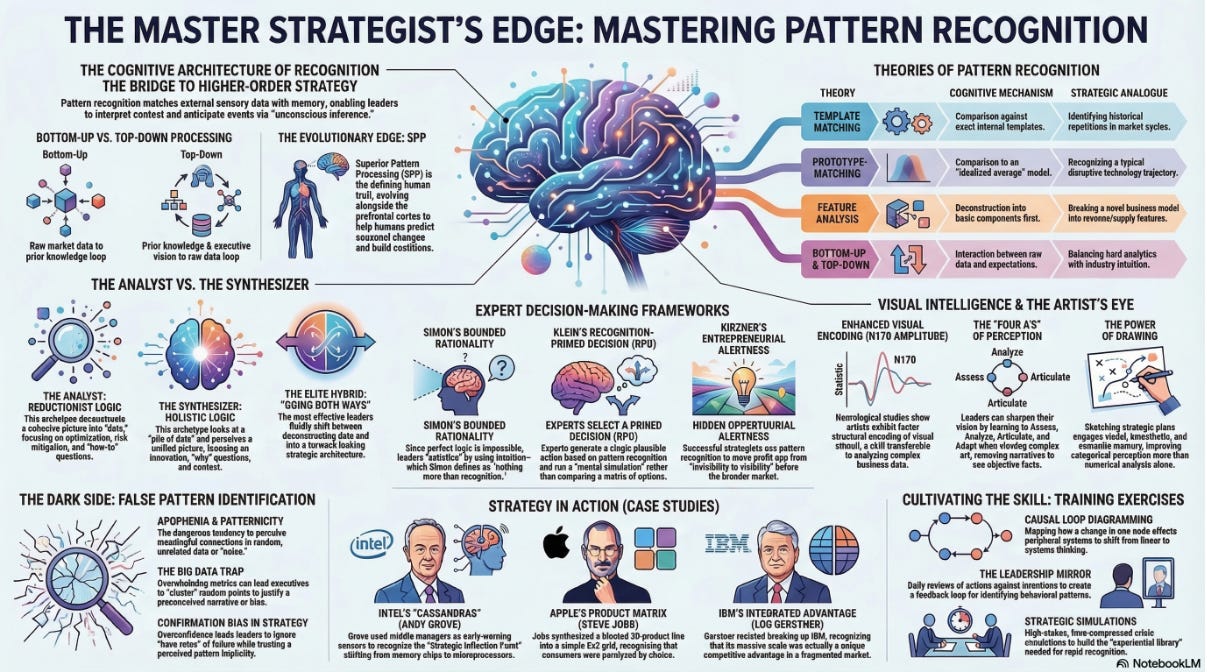
In the complex architecture of modern organizational leadership, the capacity to formulate coherent strategy relies heavily on the cognitive ability to decipher meaning from seemingly chaotic environments. The prevailing challenge for corporate strategists is rarely a deficit of data; rather, it is the profound difficulty of translating a fragmented array of discrete data points into a lucid, actionable strategic picture. As organizational environments become increasingly saturated with information, executives are frequently divided into two distinct cognitive archetypes: the analyst, who examines a cohesive picture and deconstructs it into a pile of isolated dots, and the synthesizer, who surveys a random pile of dots and perceives a unified picture. While both cognitive modalities are essential for rigorous organizational governance, the ultimate hallmark of elite strategic leadership is the capacity to fluidly oscillate between the two, synthesizing disparate variables into a holistic vision while analytically validating the constituent parts.
This cognitive alchemy is fundamentally rooted in pattern recognition. For strategists, pattern recognition is not merely a peripheral capability; it is the primary mechanism through which leaders observe moving parts, decode underlying market structures, and formulate decisive actions to accomplish organizational objectives. The ensuing comprehensive report provides an exhaustive examination of pattern recognition, exploring its precise cognitive and neurobiological definitions, its evolutionary genesis, and its developmental trajectory from innate genetic traits to honed expertise. Furthermore, the analysis integrates insights from seminal theorists in decision-making, evaluates the unique visual intelligence of artists, outlines practical exercises for cognitive enhancement, and ultimately elucidates why pattern recognition remains the paramount meta-skill for navigating strategic inflection points and mitigating the perilous cognitive trap of false pattern identification.
The evolution of artificial intelligence—from early rule-based logic to today’s advanced generative models—has been driven fundamentally by one core capability: pattern recognition. In the realm of machine learning, pattern recognition is the process of discovering regularities, similarities, and statistical correlations within massive datasets to classify information and make predictions. Today, this capability is the definitive cornerstone of AI, serving as the distinguishing mechanism that powers everything from computer vision algorithms to natural language processing.
The Shift to “Pattern Machines”
Historically, early “symbolic AI” relied on hard-coded rules and human-provided logic to mimic expertise. However, modern AI has shifted entirely toward data-driven statistical pattern recognition. Neural networks and Large Language Models (LLMs) operate essentially as highly advanced “pattern machines”. By analyzing vast amounts of training data, these systems learn to recognize complex mathematical correlations to predict the next logical outcome. Generative AI takes this capability a step further; rather than merely classifying existing data, it models the underlying structural patterns of the data it was trained on to infinitely create novel text, images, and code.
AI vs. Human Pattern Recognition
While AI can process data at a scale impossible for human analysts, its version of pattern recognition lacks true cognitive understanding. AI relies heavily on massive computational power and extensive datasets to identify statistical links. In contrast, the human brain performs pattern recognition with remarkable efficiency, requiring very few examples to learn abstract concepts and generalize them across entirely new, unpredictable contexts.
Because AI models are fundamentally inference engines optimized to generate probable continuations of patterns, they often mimic thought and fluency without actually possessing true comprehension or reasoning. This rigid reliance on statistical data also creates unique vulnerabilities. AI pattern recognition can be easily deceived by “adversarial attacks,” where subtle, human-imperceptible alterations to an input (such as a few altered pixels in an image) cause the system to completely misclassify the object.
The Strategic Imperative for Leaders
As AI assumes the heavy lifting of raw data analysis and computational pattern recognition, the human role is actively shifting. Organizations are seeing a rising demand for humans to apply their contextual pattern recognition to “edge cases” where AI agents inevitably fail or hallucinate. While AI is the ultimate analytical tool for detecting statistical signals in the noise, human leaders must provide the holistic synthesis. It is up to human strategists to interpret what those AI-generated patterns mean in a real-world context and determine which insights will actually lead to genuine organizational breakthroughs.