Strategic Confluence: A Beginner’s Guide to AI Implementation
How to actually get it done.

1. The Strategic AI Gap: Moving Beyond Arbitrary Integration
Most small-to-medium business (SMB) leadership teams understand that Artificial Intelligence is a transformative force, yet they consistently fail to harness it. This failure isn’t due to a lack of technical tools; it is a failure of Strategic Confluence. Without a structured framework, leadership teams fall into one of two destructive patterns that I call “Problem 2” failure modes.
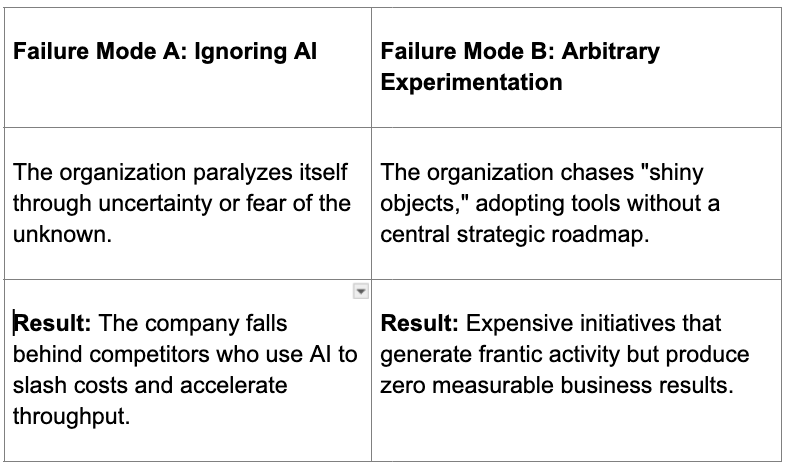
The missing element is Organizational Intelligence—the bridge between knowing what the technology can do and knowing the specific sequence and investment level required for your unique company. To avoid these traps, you must stop treating strategy as a static document and start building a Digital Twin: a living intelligence model of your company that guides AI decisions based on real-world data rather than fragmented assumptions.
To build this living model, your leadership team must first identify the anchor point that holds the entire structure together: the Core Process.
--------------------------------------------------------------------------------
2. The Anchor: Starting with the Core Process
Before you evaluate a single AI vendor, you must achieve absolute clarity on your Core Process. At the SMB scale, resources are too precious to waste on peripheral improvements. If an AI investment does not directly serve, protect, or enhance this specific workflow, it is rarely justified.
The Question It Answers: “What is the single process that, if executed with excellence, creates our competitive advantage?”
Key Insight: Identifying the Core Process serves as your ultimate strategic filter. It prevents you from being distracted by tools that optimize the wrong things. In our methodology, this is the “Strategic DNA” that ensures every dollar of AI spend is an investment in your company’s primary engine of value.
Once this anchor is secured, you can begin categorizing your AI opportunities using a framework designed for operational clarity.
--------------------------------------------------------------------------------
3. The Four-Category Framework for AI Integration
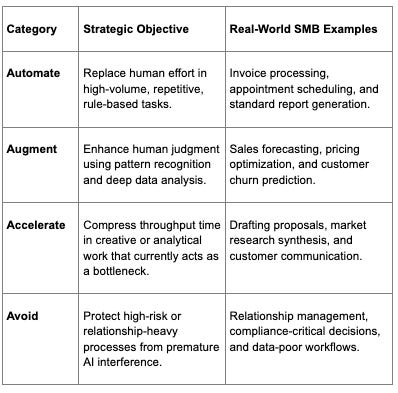
Strategic AI integration is not a monolithic task; it is a disciplined exercise in categorization. By mapping your process inventory against these four objectives, you move from “experimentation” to “execution.”
The “So What?” (Strategic Benefit):
Automate: Directly impacts your Operational Architecture by clearing bottlenecks that constrain total throughput.
Augment: Enhances your Financial Intelligence by reducing human bias in high-stakes pricing and forecasting decisions.
Accelerate: Increases your competitive velocity, allowing your team to deliver more value without increasing headcount.
Avoid: Protects your brand equity from “execution risk” and prevents expensive failures that damage organizational confidence.
Defining these categories is only half the battle; the mentor’s challenge is deciding which to tackle first.
--------------------------------------------------------------------------------
4. Prioritizing for Impact: The Time vs. Importance Matrix
Leadership teams frequently fail because they lack the rigor to prioritize. Using the TTSI assessment data and Sisney’s Organizational Physics, we evaluate every process through three critical dimensions: Time to implement, Importance to the growth strategy, and the Process Pain Level.
To find your starting point, we plot these on a matrix to identify your Quick Wins:
The Quick Win Quadrant: Focus exclusively on initiatives that are High Importance but require Low Implementation Time. This builds the “organizational muscle” needed for larger shifts.
The Weight of Friction: On our matrix, the “size of the dot” represents the Process Pain Level. A large dot signifies a high daily friction cost—the rework and frustration that drain your team’s energy.
Building Momentum: By solving for high-pain, high-importance “Quick Wins,” you generate the internal buy-in required to sustain a long-term AI roadmap.
Key Insight: Prioritization is a ruthless exercise. The “dot size” isn’t just an aesthetic choice; it’s a financial metric of the hidden costs currently bleeding out of your manual processes.
True strategic discipline, however, is as much about the “No” as it is the “Yes.”
--------------------------------------------------------------------------------
5. The Strategic Value of the “Avoid” Category
Choosing what not to do is a strategic victory, not a sign of weakness. Documenting an “Honest Avoid Category” protects your company from the “activity without results” trap mentioned in Problem 2. This is how you protect your long-term organizational confidence.
A process belongs in the “Avoid” category if it hits any of these four barriers:
Data Quality: Your internal data is too messy or sparse to provide a reliable foundation for AI.
Team Literacy: Your team lacks the current capability to manage or interpret the AI output safely.
Relationship Sensitivity: The process relies on a “human touch” that, if automated, would damage customer trust.
Execution Risk: The cost of an AI-generated error is higher than your current stage of business can absorb.
Key Insight: By explicitly naming what you will avoid, you provide your team with the “guardrails” they need to innovate safely in other areas.
With the strategy filtered and prioritized, you must move into the execution phase.
--------------------------------------------------------------------------------
6. Turning Strategy into Action: The 90-Day Sprint
A strategy that doesn’t lead to accountability is just a wish list. To transform AI from an abstract concept into a practical tool, we use the 90-Day Sprint. This ensures that every prioritized initiative has a clear pathway to integration.
Before launching any AI initiative, you must check off these six essential elements:
[ ] Specific Tool: Which software is being used, and why does it fit our specific infrastructure?
[ ] Named Owner: Who is the one person solely accountable for this project’s success?
[ ] Data Requirements: Do we have high-quality data ready to feed this tool?
[ ] Success Metric: Exactly which KPI will prove this tool is delivering a return?
[ ] Change Management: How will we train the team to adopt this new “Digital Twin” capability?
[ ] Integration Pathway: How does this connect to our existing systems and the Core Process?
Final Directive: The goal is to move AI out of the realm of “experimentation” and into the realm of “execution.” Initiatives without owners or metrics are distractions; remove them.
Closing: The Compounding Advantage
The ultimate goal of this structured approach is to create a Compounding Advantage. By using a Digital Twin and executing disciplined 90-Day Sprints, your organization accumulates a library of intelligence and experience that your competitors cannot replicate overnight.
This is not a one-time project; it is the development of a permanent, living capability. Over time, your Organizational Intelligence becomes your most valuable asset, ensuring that your strategy never goes out of date and your growth remains unconstrained.